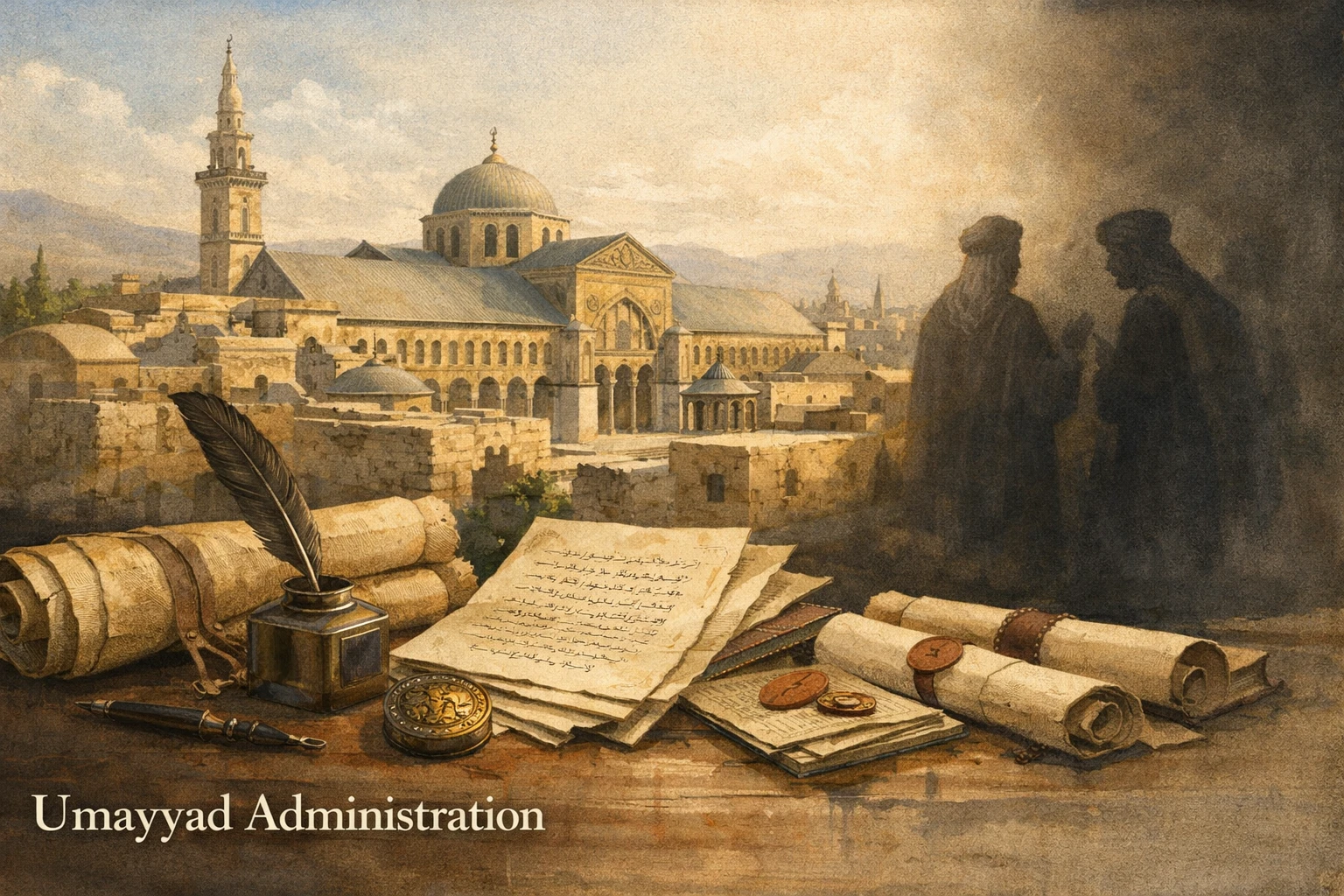
How the First Muslim Empire Actually Worked — and What It Revealed About Power in Islam
Introduction: When Faith Became Governance
Islam did not appear in history as a private belief system or a spiritual retreat from society. From its earliest days, it addressed how humans live together, resolve disputes, and exercise authority with responsibility. After the passing of the Prophet Muhammad ﷺ, the Muslim community faced a challenge that was as moral as it was political: how to preserve divine guidance while governing an ever-expanding world. By the time the Umayyad Caliphate emerged in 661 CE, Islam was no longer confined to Arabia. It ruled lands stretching from the eastern Mediterranean to Persia and beyond. The Umayyads inherited not only power, but a heavy amanat — the trust of ruling in the name of a faith that placed justice above dominance and accountability above privilege.
This post does not focus on rulers as personalities, nor on controversy alone. It examines the administrative machinery of the Umayyad state and asks a deeper question: what happens when Islamic moral ideals are tested by imperial scale?
From a Moral Community to an Imperial State
During the lifetime of the Prophet ﷺ and the Rashidun period, leadership remained visibly close to the people. Authority was restrained by personal accountability and a constant awareness of divine judgment. Governance was simple because society was small. However, as Muslim rule expanded rapidly, simplicity became impractical. Managing diverse populations, collecting revenue, maintaining security, and enforcing law across vast territories required structured administration. The Umayyads understood this reality clearly. They did not rule a village or a tribe; they ruled an empire.
Islam never rejected organization or structure. On the contrary, it demands order rooted in justice. The challenge for the Umayyads was not building systems, but ensuring those systems reflected Islamic ethical priorities. This is where tension began to emerge between political necessity and moral vision.
Damascus and the Centralization of Authority
The choice of Damascus as the capital of the Umayyad Caliphate reflected strategic realism. Syria possessed established bureaucratic traditions inherited from Byzantine governance. Roads, tax registers, military infrastructure, and administrative offices already existed. The Umayyads adapted these institutions rather than destroying them, demonstrating that Islamic rule was capable of learning from existing civilizations while reshaping them.
Yet this move also represented a symbolic shift. Medina had been the city of prophetic presence and communal intimacy. Damascus was the city of command. Authority moved from proximity to revelation toward centralized control. Islam permits authority, but it constantly warns against arrogance and distance from accountability. As power consolidated, maintaining humility became increasingly difficult — not because Islam failed, but because humans struggle when power grows faster than conscience.
Governors: Where Islam Was Actually Experienced
For the majority of people living under Umayyad rule, Islam was not encountered through scholars or scripture, but through governors. In provinces like Egypt, Iraq, Khurasan, and North Africa, the governor embodied the state and, by extension, Islam itself. Justice delivered by him strengthened faith; injustice eroded trust. The Qur’an repeatedly emphasizes that authority is a trust, not ownership, and that leadership without justice is corruption.
The Umayyad system granted governors broad powers to maintain order and collect revenue. Some exercised restraint, aware that leadership would be questioned before Allah. Others ruled harshly, prioritizing stability over fairness. The administrative structure allowed both to exist. Accountability was inconsistent, and this inconsistency created resentment, particularly among non-Arab Muslims who often experienced Islam not as equality, but as hierarchy.
This gap between Islamic ideals and administrative reality did not weaken Islam. It exposed where governance failed to rise to Islam’s standard.
Military Power and the Limits of Expansion
The Umayyad state relied heavily on military strength. Expansion brought wealth, loyalty, and political legitimacy. Soldiers were paid from state revenue, and victories reinforced authority. For a time, this system functioned effectively. However, it also created dependence. Legitimacy became tied to conquest, and loyalty became tied to payment.
Islamic teachings emphasize restraint even in power. Victory is not proof of righteousness, and strength is not permission for injustice. When expansion slowed, the system’s weaknesses surfaced. Soldiers expected rewards, factions competed for influence, and the state struggled to balance resources with expectations. Power built primarily on expansion can grow rapidly, but it cannot stabilize without ethical reform.
Revenue, Taxation, and the Crisis of Equality
Economically, the Umayyad administration was efficient. Taxes were collected, trade routes flourished, and state institutions functioned. Yet efficiency alone does not satisfy Islamic justice. In many regions, non-Arab converts continued to bear tax burdens even after accepting Islam, contradicting the Qur’anic spirit of equality and dignity. This practice deeply troubled scholars and communities alike.
Islam does not abolish economic responsibility, but it insists that faith dissolves artificial hierarchies. When administration failed to reflect this principle, resentment grew. Conversion lost its promise of social justice, and governance lost its moral credibility. The issue was not Islam; it was the failure to apply Islam consistently.
Law, Judges, and the Rise of Scholarly Conscience
During the Umayyad era, legal authority remained closely tied to the state. Judges were appointed by rulers, and law often served political needs. While Islamic law existed, it lacked institutional independence. Over time, scholars recognized the danger of this arrangement. Moral authority could not survive if it remained subordinate to political power.
Ironically, Umayyad governance contributed to one of Islam’s greatest strengths: the emergence of an independent scholarly tradition. When rulers compromised justice, scholars preserved conscience. When power demanded obedience, knowledge demanded integrity. Islam proved resilient not because states were perfect, but because truth was never confined to the palace.
Language, Culture, and Civilizational Unity
One of the Umayyads’ most enduring achievements was the Arabization of administration. Arabic replaced Greek and Persian as the language of governance, creating administrative unity across the empire. This decision was not merely cultural pride; it was a strategic step toward coherence. A shared administrative language allowed law, scholarship, and knowledge to circulate freely.
This reform laid the groundwork for later intellectual flourishing. Without administrative unity, the Islamic Golden Age would not have been possible. Even where the Umayyads struggled morally, they built foundations others would refine with greater justice.
Character and Power: A Moral Test
At its core, Umayyad administration reveals a human struggle. Rulers faced pressures unknown to earlier leaders. Managing diversity, suppressing rebellion, and maintaining order demanded compromise. Yet Islam never promised leadership without sacrifice. It promised accountability. Some leaders feared God more than rebellion. Others feared rebellion more than God. That difference shaped history more than lineage or dynasty.
Islam’s strength lies in its refusal to sanctify power. Authority is judged, not worshipped. Failure is exposed, not hidden.
Umayyad Administration System and Governance
Conclusion: What the Umayyad System Teaches Us
The Umayyads built the machinery of empire — administration, military organization, taxation, and centralized rule. These systems allowed Islam to survive politically across vast territories. But Islam was never meant to be preserved by machinery alone. It survives through conscience, justice, and moral accountability.
The Umayyad experience teaches a lasting lesson: Islam does not collapse when rulers fail; it exposes failure by holding rulers to a higher standard. This is not a weakness. It is a civilizational strength that allows faith to outlive dynasties.
Key Takeaways
- The Umayyads established the first functioning Muslim imperial administration
- Centralization strengthened control but strained moral legitimacy
- Islam’s ethical framework remained intact despite political shortcomings
- Scholarly independence emerged as a response to compromised authority