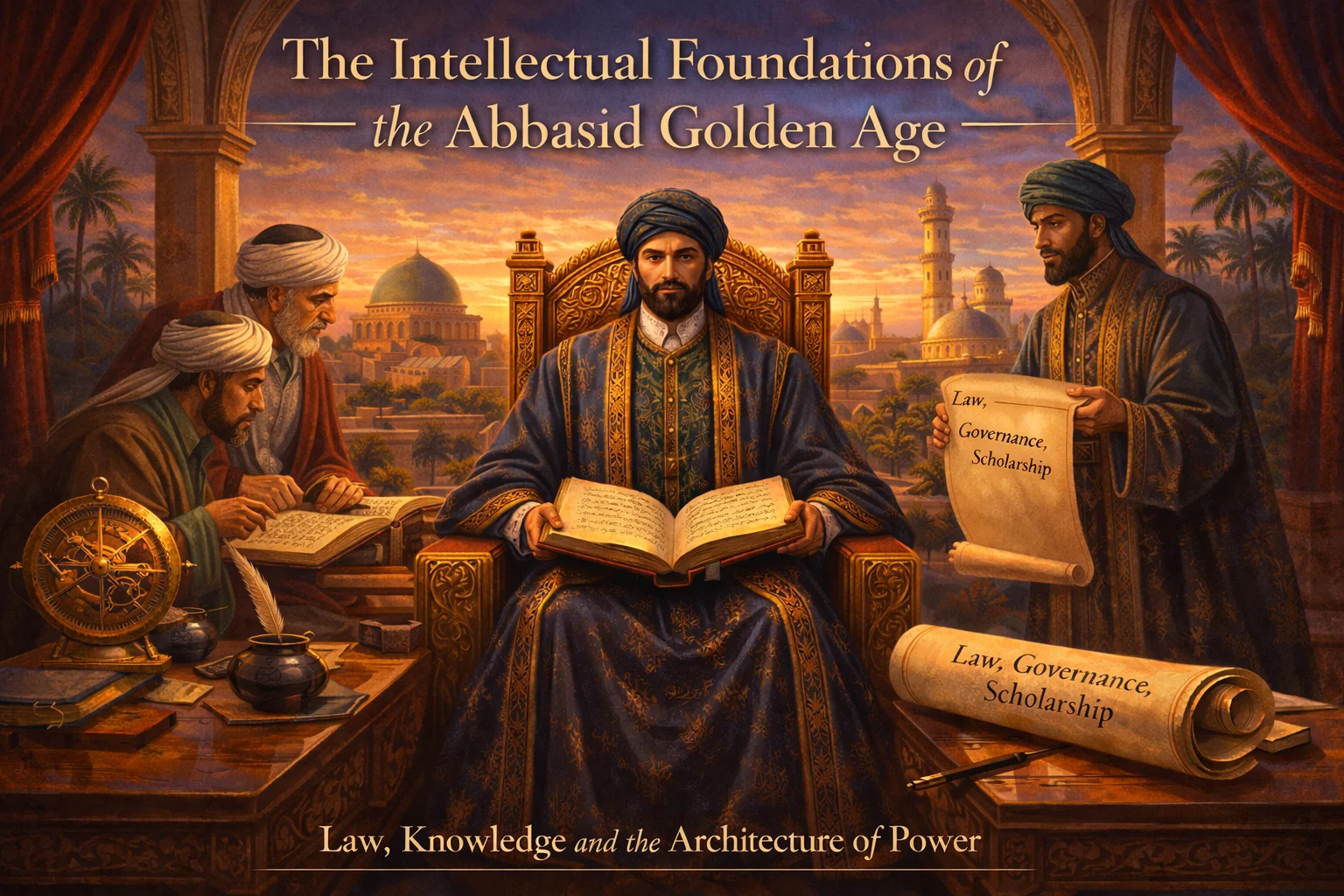
The Intellectual Foundations of the Abbasid Golden Age
In the decades after 750 CE, when the Abbasid banners replaced those of the Umayyads, the Islamic world did not immediately enter a golden age of knowledge. What followed first was something far less glamorous and far more difficult: a struggle to redefine authority. The revolution had succeeded militarily, but military victory did not answer deeper questions. Who had the right to interpret Islam? Who controlled law? Could the caliph command belief, or only enforce order? Between 754 and the early ninth century, especially under the rule of Abu Jaʿfar al-Manṣūr (r. 754–775 CE) and his successors, the Abbasid state confronted these tensions directly. The period that later historians would celebrate as the beginning of the Islamic Golden Age was in reality born out of administrative necessity, legal debate, theological conflict, and social transformation. The brilliance came later. The foundation came first.
The Abbasids inherited an empire stretching from North Africa to Central Asia. Its population was no longer overwhelmingly Arab. Persian converts, Central Asian soldiers, Iraqi urban elites, Syrian tribes, Egyptian farmers, and Andalusian émigrés all lived under the same caliphate. Under the Umayyads, Arab tribal identity had functioned as a political glue. Under the Abbasids, that glue no longer held. The new dynasty had risen partly by promising broader inclusion, especially to non-Arab Muslims known as mawali. But inclusion required structure. A diverse empire demanded a common intellectual and legal language. Without it, regional governors could drift toward autonomy, religious disputes could fracture society, and political rivals could claim divine legitimacy.
This is where the story of knowledge begins — not in libraries, but in governance.
Baghdad and the Reorientation of Power
When al-Manṣūr founded Baghdad in 762 CE, he did more than build a capital. He shifted the geographic center of the Islamic world eastward. Damascus had symbolized Arab-Syrian dominance. Baghdad symbolized imperial reconfiguration. Positioned near the Tigris River and close to former Persian administrative centers, it allowed the Abbasids to draw on long-established bureaucratic traditions. Persian secretaries and administrators entered government service in increasing numbers. Arabic remained the language of religion and state, but administrative practice became more systematized, influenced by Sasanian models of record-keeping and taxation.
The design of Baghdad itself — circular, with the caliph’s palace and mosque at its center — reflected a political philosophy. Authority radiated outward from a single point. Yet this centralization also revealed a vulnerability. The more complex the state became, the more it depended on specialists: judges, secretaries, scholars, translators. Power was no longer only military. It was intellectual.
The Emergence of Legal Authority
By the late eighth century, Islamic law was no longer an informal system derived from local custom and scattered precedent. Scholars in cities such as Kufa, Basra, and Medina began developing structured legal reasoning. Figures like Abu Hanifa (d. 767 CE) in Iraq and Malik ibn Anas (d. 795 CE) in Medina articulated methods for deriving rulings from the Qur’an and Prophetic tradition. Their work did not originate from the palace. It emerged from mosques, teaching circles, and scholarly debate.
This distinction mattered.
Under the Abbasids, the caliph appointed judges (qadis), but increasingly those judges relied on scholarly methodologies that were independent of political command. Law became anchored in transmitted knowledge and juristic reasoning rather than in direct caliphal decree. The result was subtle but revolutionary: religious authority began to separate from executive power. The caliph remained the political head of the Muslim community, but he was not the sole interpreter of divine law.
This division stabilized society. Merchants in Baghdad, farmers in Egypt, and traders in Khurasan could appeal to a recognized legal framework. Disputes were resolved not by tribal negotiation but by juristic reasoning. The Abbasids did not lose power in this process; they gained legitimacy. Yet they also limited themselves. Future conflicts between rulers and scholars would grow from this early equilibrium.
The Hadith Movement and the Search for Authenticity
As legal schools took shape, a parallel movement gathered force: the systematic collection of Hadith. Reports about the sayings and actions of the Prophet Muhammad ﷺ circulated widely, but not all were authentic. Political conflicts during the Umayyad period had produced fabricated traditions supporting various factions. The Abbasid era saw scholars intensify efforts to verify transmission chains (isnad). This methodological rigor culminated in the ninth century with compilations such as those of Muhammad ibn Ismaʿil al-Bukhari (d. 870 CE), but the groundwork was laid earlier.
The impulse behind this movement was not abstract piety alone. It was social necessity. A rapidly expanding Muslim society required clarity. How should contracts be written? What constitutes fair taxation? How should inheritance be divided in mixed tribal families? Reliable prophetic precedent became essential for unity.
The Abbasid state did not invent this scholarship, but it benefited from it. A population confident in its legal and theological foundations was less likely to fracture into sectarian chaos. Knowledge, therefore, became a pillar of political order.
Translation as Statecraft
During the reign of al-Manṣūr and later under Harun al-Rashid (r. 786–809 CE) and al-Maʾmun (r. 813–833 CE), translation efforts expanded significantly. Greek medical works by Galen, philosophical texts by Aristotle, Persian administrative manuals, and Indian astronomical treatises were translated into Arabic. The establishment of institutions later known as the Bayt al-Hikma in Baghdad symbolized this movement.
Yet the motive was not cultural vanity. Astronomy assisted in determining prayer times and calendar calculations. Medicine improved urban public health. Mathematics enhanced fiscal management. Even philosophy sharpened dialectical tools used in theological debate.
Muslim scholars did not passively absorb foreign ideas. They critiqued them, reconciled them with Islamic theology, or rejected them when necessary. This intellectual confidence defined the Abbasid approach. Engagement did not equal imitation. It was a process of filtration and integration within an Islamic worldview.
Social Mobility and Urban Culture
The intellectual transformation of the Abbasid period was inseparable from social change. Baghdad became one of the largest cities in the world, attracting merchants from India, scholars from Transoxiana, and artisans from Syria. Urban life encouraged literacy and debate. Education became a pathway to influence. Non-Arab Muslims, once marginalized, could now rise through scholarship or administrative skill.
This did not eliminate inequality. Rural taxation remained heavy, and political power still rested with the caliph. But the criteria for prestige shifted. Learning conferred honor. A jurist’s opinion could influence governors. A scholar’s refusal to endorse a policy could challenge authority.
This dynamic relationship between power and knowledge created tension. It also generated creativity.
Theological Debate and the Limits of Authority
The early Abbasid period witnessed intense theological discussion. Questions about free will, divine attributes, and the nature of the Qur’an occupied scholars and rulers alike. Under al-Maʾmun, the famous mihna (inquisition) attempted to enforce the doctrine that the Qur’an was created. Scholars such as Ahmad ibn Hanbal (d. 855 CE) resisted state coercion. The episode revealed the boundaries of caliphal power. The state could imprison dissenters, but it could not permanently command belief.
In the long term, the failure of the mihna strengthened scholarly autonomy. The Abbasid caliphate emerged more cautious about intervening directly in theological doctrine. This outcome preserved a balance that allowed intellectual growth without absolute political domination.
Foundations of the Golden Age
By the early ninth century, the essential components of the Golden Age were in place: administrative stability, legal clarity, scholarly independence, translation networks, and an urban culture that valued debate. When figures such as al-Khwarizmi (d. c. 850 CE) advanced algebra, or when physicians refined medical practice, they operated within a system already prepared to sustain innovation.
The Golden Age was therefore not a sudden eruption of genius. It was the logical extension of decades of structural preparation.
Conclusion: Structure Before Brilliance
The early Abbasid period teaches a crucial lesson about civilization. Intellectual flourishing requires political order. Legal coherence requires scholarly integrity. Cultural confidence requires engagement without surrender. Between 754 and 833 CE, the Abbasids and the scholars of the Muslim world constructed a framework durable enough to support centuries of achievement.
What later generations celebrate as a golden age was rooted in discipline, debate, and institutional design. The Abbasids did not merely inherit an empire. They reshaped the conditions under which knowledge itself could thrive.