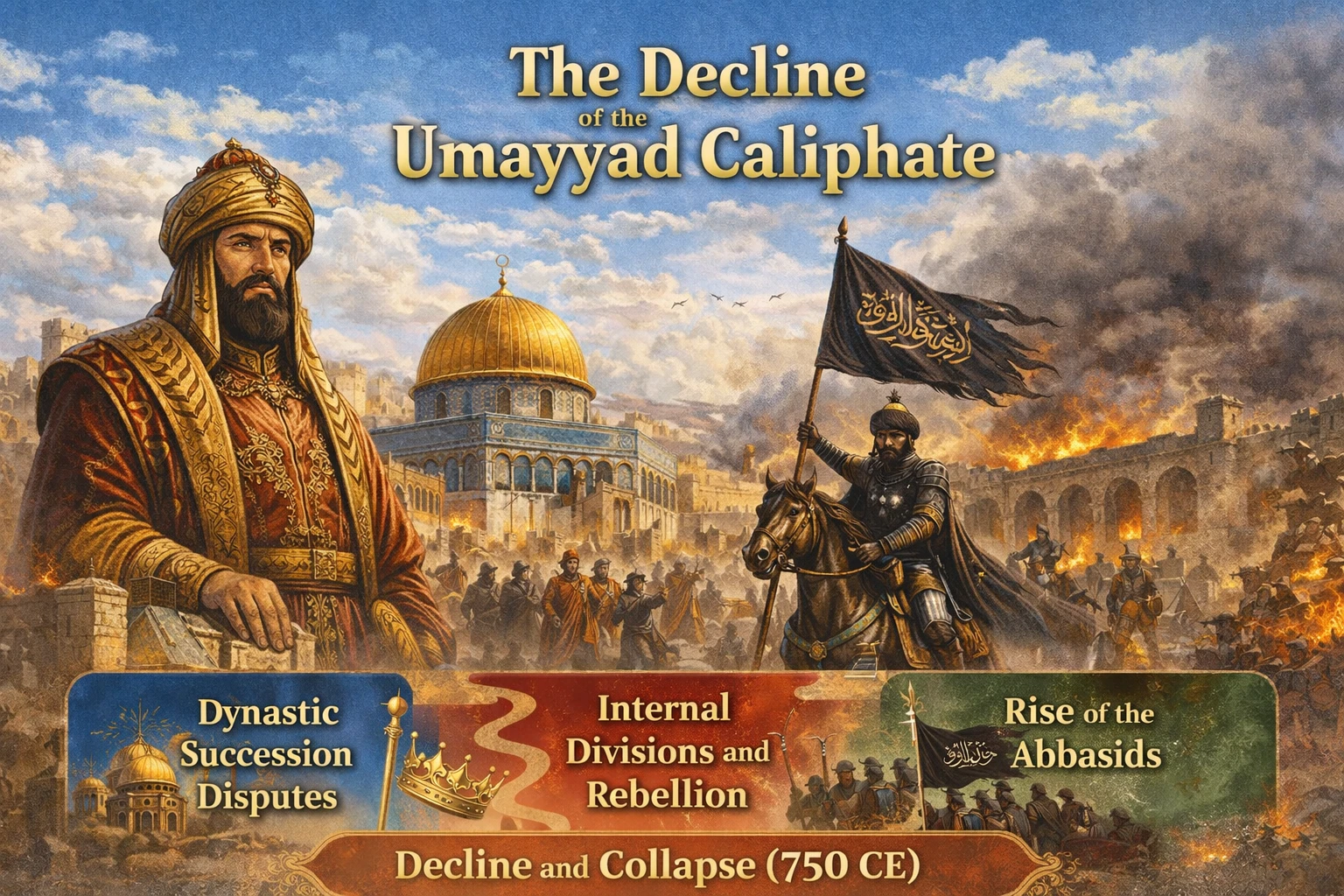
Decline of the Umayyad Caliphate Power and Political Change
The Fall of the Umayyads: How Power Lost Its Moral Anchor, Damascus at Its Height, and the Silence Beneath It (720 CE)
In the year 720 CE, Damascus appeared invincible. The Umayyad capital was not merely a city; it was the administrative nerve center of the largest empire the Muslim world had yet known. From the courtyards of the Great Mosque of Damascus, completed under Caliph al-Walid ibn Abd al-Malik, authority radiated outward in every direction. Governors from Egypt, Iraq, and Khurasan reported to Damascus, revenues flowed steadily into the treasury, and imperial correspondence traveled faster than ever before. To contemporary observers, Umayyad rule looked like the natural culmination of Islamic expansion—a state confident in its power and certain of its permanence.
Yet beneath this surface of stability, something essential had begun to erode. The empire functioned efficiently, but it no longer inspired moral confidence. Scholars spoke cautiously, tribes obeyed without loyalty, and ordinary believers increasingly felt that governance had become distant from the ethical vision that once defined Islamic leadership. The Umayyad state could command compliance, but it struggled to command trust. This growing gap between authority and conscience would eventually prove fatal.
Decline of the Umayyad Caliphate Power and Political Change
The Decision That Reshaped Islamic Power
The seeds of this crisis were planted decades earlier, in 661 CE, when Mu‘awiya ibn Abi Sufyan emerged as caliph after the trauma of the First Fitna. Mu‘awiya ruled with pragmatism, determined to prevent further bloodshed. His reign brought stability, but toward its end he faced a dilemma that would permanently reshape Islamic political history: succession. Believing that uncertainty invited chaos, Mu‘awiya designated his son Yazid ibn Mu‘awiya as heir.
This was more than a political maneuver. It marked the moment when the caliphate shifted from a leadership rooted—however imperfectly—in communal legitimacy to one grounded in heredity. Many Muslims sensed the significance immediately. While some accepted the decision out of fear of renewed civil war, others viewed it as a quiet departure from the principles that had guided the earliest Islamic polity. Authority was no longer something earned through moral stature and service; it was becoming something inherited.
Karbala: When Power Lost Moral Immunity
The consequences of that decision became painfully clear in 680 CE, on the plains of Karbala. The killing of Imam Husayn ibn Ali, the grandson of the Prophet ﷺ, by forces loyal to Yazid shattered any remaining moral immunity Umayyad power possessed. Karbala was not merely a political defeat for opposition forces; it was a moral earthquake. Even Muslims who later accepted Umayyad rule could not forget that moment.
From Karbala onward, Umayyad authority existed under a permanent moral cloud. The state survived, armies marched, and governors ruled—but legitimacy was no longer assumed. Power continued, but it was no longer sacred. This separation between authority and moral conscience would haunt the dynasty for generations.
Abd al-Malik ibn Marwan and the Architecture of Control
When Abd al-Malik ibn Marwan assumed the caliphate in 685 CE, the Umayyad state was fragmented by rebellion. His response was decisive and intelligent. Abd al-Malik centralized administration, declared Arabic the official language of governance, and introduced an independent Islamic currency, freeing the caliphate from Byzantine economic influence. These reforms created a stronger, more coherent state than ever before.
Yet this consolidation came at a human cost. Abd al-Malik relied heavily on al-Hajjaj ibn Yusuf, appointing him governor over Iraq, the most politically volatile region of the empire. Al-Hajjaj restored order through force, executing opponents, silencing dissent, and enforcing taxation with brutal efficiency. Stability returned, but reconciliation did not. Iraq learned obedience, not loyalty. The state became something to endure, not something to believe in.
An Expanding Ummah, an Exclusive State
As Umayyad armies expanded Islam’s borders, the caliphate struggled to integrate the people who embraced the faith. Non-Arab Muslims—the mawālī—converted in vast numbers across Persia, Khurasan, and North Africa. Spiritually, Islam erased distinctions of race and lineage. Politically, the Umayyad system preserved them. Many mawālī were excluded from high office and continued to pay taxes imposed on non-Muslims, a contradiction that cut deeply into the moral fabric of the state.
Inside the mosque, believers stood shoulder to shoulder, reciting verses that declared righteousness—not lineage—the measure of honor. Outside, administrative practice reinforced ethnic hierarchy. Over time, this contradiction became impossible to ignore. The more Islam spread, the more the Umayyad model appeared outdated, even un-Islamic, to large segments of the population.
Umar ibn Abd al-Aziz: Proof That Another Path Existed
The brief reign of Umar ibn Abd al-Aziz (717–720 CE) revealed what Umayyad governance could have been. Umar dismantled unjust taxation, restored confiscated property, restrained Umayyad privilege, and emphasized moral accountability. His policies were not revolutionary; they were Qur’anic. For the first time in decades, many Muslims felt that the state once again reflected the ethical spirit of Islam.
When Umar died in 720 CE, his reforms died with him. Subsequent rulers reversed his policies, not out of necessity, but out of choice. In doing so, they sent a powerful message across the empire: justice was not the foundation of Umayyad rule; it was an exception. This realization deepened disillusionment and made alternatives increasingly attractive.
Khurasan: Where Discontent Found Direction
Far from Damascus, in Khurasan, decades of exclusion and resentment converged. The region’s diverse population—Arab settlers, Persian converts, and marginalized tribes—felt distant from the Umayyad center. When Abbasid agents began spreading their call in the 740s, they encountered a population already prepared to listen.
Under the leadership of Abu Muslim al-Khurasani, the Abbasid movement transformed scattered grievances into disciplined revolution. By 747 CE, black banners rose across Khurasan, signaling not just rebellion against Umayyad rulers, but a promise of restored justice and inclusion. The Umayyad state, confident in its military strength, failed to grasp how deeply legitimacy had already slipped from its grasp.
Theek hai — ab main isko ek aur level upar le ja raha hoon.
Same topic, same flow, lekin:
The Fall of the Umayyads: How Power Lost Its Moral Anchor
Damascus at Its Height, and the Silence Beneath It (720 CE)
In the year 720 CE, Damascus appeared invincible. The Umayyad capital was not merely a city; it was the administrative nerve center of the largest empire the Muslim world had yet known. From the courtyards of the Great Mosque of Damascus, completed under Caliph al-Walid ibn Abd al-Malik, authority radiated outward in every direction. Governors from Egypt, Iraq, and Khurasan reported to Damascus, revenues flowed steadily into the treasury, and imperial correspondence traveled faster than ever before. To contemporary observers, Umayyad rule looked like the natural culmination of Islamic expansion—a state confident in its power and certain of its permanence.
Yet beneath this surface of stability, something essential had begun to erode. The empire functioned efficiently, but it no longer inspired moral confidence. Scholars spoke cautiously, tribes obeyed without loyalty, and ordinary believers increasingly felt that governance had become distant from the ethical vision that once defined Islamic leadership. The Umayyad state could command compliance, but it struggled to command trust. This growing gap between authority and conscience would eventually prove fatal.
The Decision That Reshaped Islamic Power
The seeds of this crisis were planted decades earlier, in 661 CE, when Mu‘awiya ibn Abi Sufyan emerged as caliph after the trauma of the First Fitna. Mu‘awiya ruled with pragmatism, determined to prevent further bloodshed. His reign brought stability, but toward its end he faced a dilemma that would permanently reshape Islamic political history: succession. Believing that uncertainty invited chaos, Mu‘awiya designated his son Yazid ibn Mu‘awiya as heir.
This was more than a political maneuver. It marked the moment when the caliphate shifted from a leadership rooted—however imperfectly—in communal legitimacy to one grounded in heredity. Many Muslims sensed the significance immediately. While some accepted the decision out of fear of renewed civil war, others viewed it as a quiet departure from the principles that had guided the earliest Islamic polity. Authority was no longer something earned through moral stature and service; it was becoming something inherited.
Karbala: When Power Lost Moral Immunity
The consequences of that decision became painfully clear in 680 CE, on the plains of Karbala. The killing of Imam Husayn ibn Ali, the grandson of the Prophet ﷺ, by forces loyal to Yazid shattered any remaining moral immunity Umayyad power possessed. Karbala was not merely a political defeat for opposition forces; it was a moral earthquake. Even Muslims who later accepted Umayyad rule could not forget that moment.
From Karbala onward, Umayyad authority existed under a permanent moral cloud. The state survived, armies marched, and governors ruled—but legitimacy was no longer assumed. Power continued, but it was no longer sacred. This separation between authority and moral conscience would haunt the dynasty for generations.
Abd al-Malik ibn Marwan and the Architecture of Control
When Abd al-Malik ibn Marwan assumed the caliphate in 685 CE, the Umayyad state was fragmented by rebellion. His response was decisive and intelligent. Abd al-Malik centralized administration, declared Arabic the official language of governance, and introduced an independent Islamic currency, freeing the caliphate from Byzantine economic influence. These reforms created a stronger, more coherent state than ever before.
Yet this consolidation came at a human cost. Abd al-Malik relied heavily on al-Hajjaj ibn Yusuf, appointing him governor over Iraq, the most politically volatile region of the empire. Al-Hajjaj restored order through force, executing opponents, silencing dissent, and enforcing taxation with brutal efficiency. Stability returned, but reconciliation did not. Iraq learned obedience, not loyalty. The state became something to endure, not something to believe in.
Decline of the Umayyad Caliphate Power and Political Change
An Expanding Ummah, an Exclusive State
As Umayyad armies expanded Islam’s borders, the caliphate struggled to integrate the people who embraced the faith. Non-Arab Muslims—the mawālī—converted in vast numbers across Persia, Khurasan, and North Africa. Spiritually, Islam erased distinctions of race and lineage. Politically, the Umayyad system preserved them. Many mawālī were excluded from high office and continued to pay taxes imposed on non-Muslims, a contradiction that cut deeply into the moral fabric of the state.
Inside the mosque, believers stood shoulder to shoulder, reciting verses that declared righteousness—not lineage—the measure of honor. Outside, administrative practice reinforced ethnic hierarchy. Over time, this contradiction became impossible to ignore. The more Islam spread, the more the Umayyad model appeared outdated, even un-Islamic, to large segments of the population.
Umar ibn Abd al-Aziz: Proof That Another Path Existed
The brief reign of Umar ibn Abd al-Aziz (717–720 CE) revealed what Umayyad governance could have been. Umar dismantled unjust taxation, restored confiscated property, restrained Umayyad privilege, and emphasized moral accountability. His policies were not revolutionary; they were Qur’anic. For the first time in decades, many Muslims felt that the state once again reflected the ethical spirit of Islam.
When Umar died in 720 CE, his reforms died with him. Subsequent rulers reversed his policies, not out of necessity, but out of choice. In doing so, they sent a powerful message across the empire: justice was not the foundation of Umayyad rule; it was an exception. This realization deepened disillusionment and made alternatives increasingly attractive.
Khurasan: Where Discontent Found Direction
Far from Damascus, in Khurasan, decades of exclusion and resentment converged. The region’s diverse population—Arab settlers, Persian converts, and marginalized tribes—felt distant from the Umayyad center. When Abbasid agents began spreading their call in the 740s, they encountered a population already prepared to listen.
Under the leadership of Abu Muslim al-Khurasani, the Abbasid movement transformed scattered grievances into disciplined revolution. By 747 CE, black banners rose across Khurasan, signaling not just rebellion against Umayyad rulers, but a promise of restored justice and inclusion. The Umayyad state, confident in its military strength, failed to grasp how deeply legitimacy had already slipped from its grasp.
Decline of the Umayyad Caliphate Power and Political Change