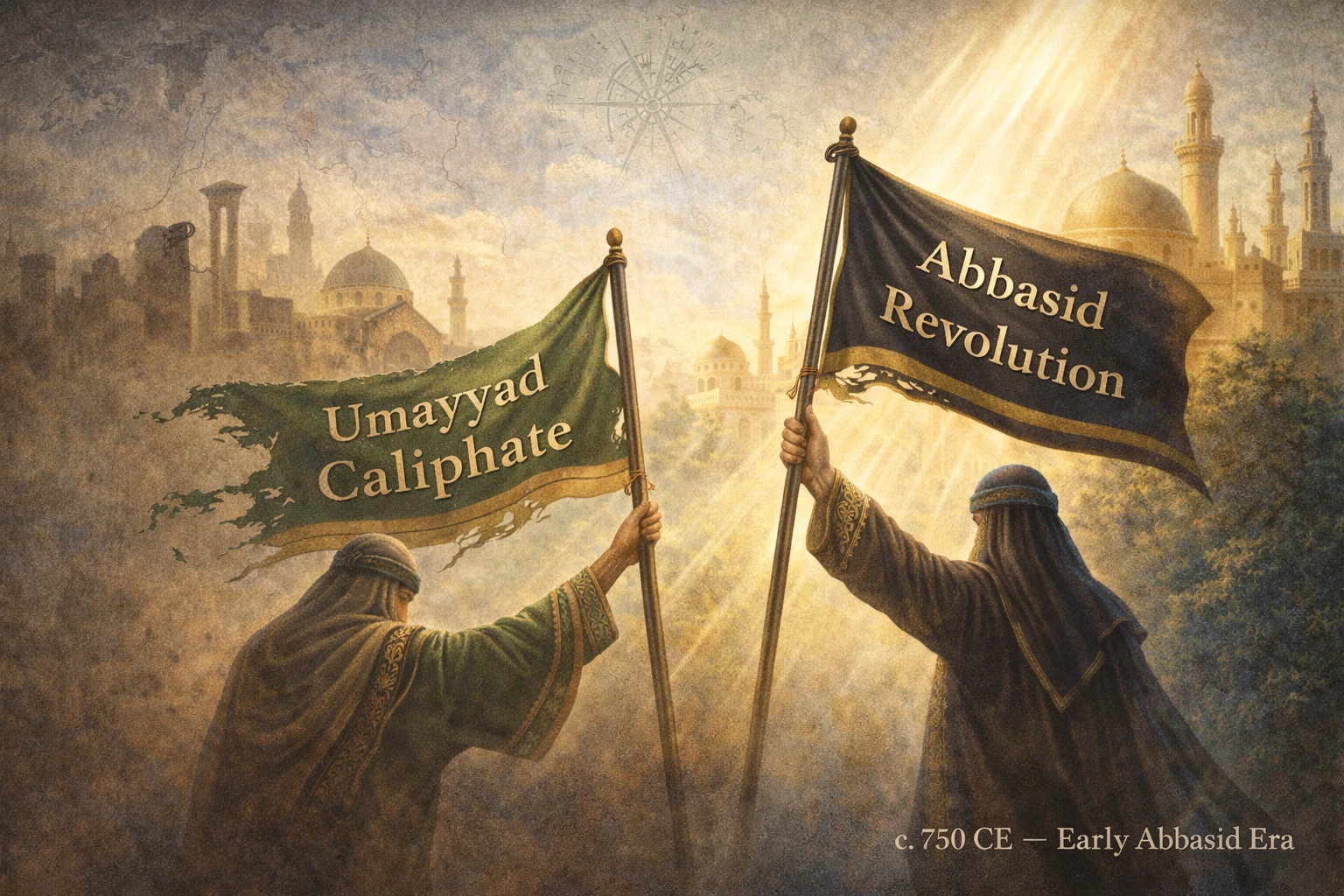
An Empire That Looked Stable but Had Already Started Cracking
In the years following 720 CE, the Umayyad Caliphate stood at its greatest territorial extent, yet it was entering one of its most fragile internal phases. The death of Caliph Umar ibn Abd al-Aziz marked a quiet but decisive turning point. His short reign had attempted to realign governance with Qur’anic ethics—ending discriminatory taxation on non-Arab Muslims, restraining governors, and emphasizing moral accountability. When he died, those reforms were not reversed overnight, but they were slowly hollowed out. What followed was not a return to chaos, but a return to administrative efficiency without moral direction.
Under Yazid II (r. 720–724) and especially Hisham ibn Abd al-Malik (r. 724–743), the Umayyad state functioned smoothly on paper. Revenue flowed from provinces, armies guarded the frontiers, and Damascus remained the symbolic heart of power. But governance had become increasingly Syrian-centric, dependent on tribal loyalties and inherited authority. Iraq, Persia, and Khurasan felt distant—not just geographically, but politically. The empire was being ruled, but it was no longer being shared.
This distinction mattered more than the Umayyads realized.
Mawālī, Conversion, and the Question the State Could Not Answer
By the early eighth century, Islam was no longer an Arab religion practiced by a conquering elite. In regions such as Khurasan, Transoxiana, and Persia, large populations had converted sincerely to Islam. These converts prayed, paid zakat, and identified themselves as part of the Ummah. Yet in practice, many remained classified as mawālī—clients attached to Arab tribes, excluded from senior military posts, and in some regions still burdened with taxes originally meant for non-Muslims.
This was not merely social injustice; it was a theological contradiction. The Qur’an had dismantled tribal superiority in belief, but the empire had quietly reconstructed it in administration. Governors enforced these distinctions not out of ideological hostility, but because the system they inherited depended on Arab privilege to maintain order and reward loyalty. Over time, however, this produced a growing sense that the Umayyad state represented Islam politically but not morally.
Among scholars, merchants, soldiers, and converts, a dangerous thought began to circulate:
If the state contradicts Islam’s promise of justice, does it still deserve obedience?
The Umayyads never provided a convincing answer.
Learning from Failure: How the Abbasids Chose a Different Path
Earlier opposition movements had confronted Umayyad authority directly—and paid the price. Kharijite revolts were annihilated. Shi‘i uprisings centered in Kufa were crushed. These failures taught future challengers an essential lesson: open rebellion invited immediate destruction.
The Abbasids absorbed this lesson fully.
Beginning in the 720s, members of the Abbasid family—descendants of al-‘Abbas ibn ‘Abd al-Muttalib, the Prophet’s ﷺ uncle—began organizing a movement that avoided confrontation and emphasized patience. Their agents did not denounce the Umayyads publicly. Instead, they spoke quietly of injustice, moral decline, and the need for leadership closer to the Prophet’s family. They avoided specifying whether this meant the line of ‘Ali or the broader Banu Hashim, allowing different audiences to hear what they wished.
This ambiguity was deliberate. It transformed Abbasid ideology into a container—one that could hold the frustrations of many groups without forcing agreement on the future.
Khurasan: Where Distance Became Opportunity
No region proved more decisive than Khurasan. Located far from Damascus, Khurasan was politically neglected, ethnically diverse, and socially volatile. Arab settlers from rival tribes coexisted uneasily with large populations of Persian Muslims who felt excluded despite loyalty to Islam. Umayyad governors rotated frequently, focusing on tax collection and military recruitment rather than long-term stability.
Abbasid missionaries recognized Khurasan not as a problem province, but as an opportunity.
By the early 740s, Abbasid networks there had grown deep and disciplined. When Abu Muslim al-Khurasani emerged as their leader, the movement gained its decisive edge. Abu Muslim was neither a theologian nor a nobleman. He was an organizer—ruthless, efficient, and politically astute. He unified Arab dissidents and non-Arab Muslims under a single command structure, enforcing discipline where ideology alone could not.
Under his leadership, Abbasid sympathies turned into parallel authority.
Crisis at the Center: Umayyad Power Begins to Fragment
The Umayyad collapse accelerated after 743 CE, when Hisham ibn Abd al-Malik died. His long reign had held the empire together through experience and authority. What followed was chaos. Al-Walid II was assassinated. Yazid III ruled briefly before dying. Ibrahim barely held power. Tribal rivalries—especially between Qays and Kalb factions—split the army and court alike.
By the time Marwan ibn Muhammad (Marwan II) seized power in 744 CE, the caliphate was already fractured. Marwan was a capable general, hardened on the Byzantine frontier, but his instincts favored military solutions to political problems. He attempted to reassert control through campaigns and force, shifting his base away from Damascus. Yet each march exposed the truth: the empire still obeyed, but it no longer believed.
From Silent Opposition to Open Revolution
In 747 CE, Abbasid forces in Khurasan openly revolted under black banners, a symbolic rejection of Umayyad legitimacy. The choice of color mattered—it signaled mourning for injustice and the end of an era. Province after province collapsed, often without major battles. Governors defected. Soldiers switched sides. Cities calculated survival.
The Umayyads still possessed armies, but they lacked unity and conviction. When Marwan II finally confronted the Abbasids, the struggle was no longer about territory. It was about which vision of Islamic rule felt credible.
That question would be answered at the Great Zab River in 750 CE.
From Collapse to Continuity: How the Abbasids Took Power After the Umayyads
The Battle of the Zab: Decisions, Miscalculations, and the Moment Authority Died
In the winter of January 750 CE, Caliph Marwan ibn Muhammad reached the banks of the Great Zab River, fully aware that this battle would decide more than territory. For years, Marwan had relied on military force to contain rebellion, believing that discipline and experience could compensate for a crumbling political base. His army was composed largely of Syrian veterans—men trained in frontier warfare against Byzantium—but they were now operating far from familiar ground, surrounded by uncertainty and divided loyalties.
The Abbasid army facing him was different in composition and spirit. Led in the field by commanders appointed by Abu Muslim al-Khurasani, it drew strength from Persian converts, Arab dissidents, and tribal groups united not by tradition, but by expectation. These soldiers believed the Umayyad order was already finished; they were fighting to claim what they saw as inevitable. That psychological asymmetry mattered more than numbers.
Marwan chose to stand and fight rather than retreat further west, a decision shaped by necessity rather than confidence. Retreat would have signaled collapse to provinces still undecided. Yet standing his ground forced him into battle without unified command. Tribal divisions within his army—especially between Qaysi and Yemeni factions—resurfaced at the worst possible moment. Orders were questioned, coordination faltered, and when Abbasid forces crossed the river, Umayyad resistance fractured rapidly.
The defeat was not total annihilation, but it was decisive. Soldiers broke formation. Officers abandoned positions. What collapsed at the Zab was not merely an army, but the idea that Umayyad authority could still impose order. Once that belief vanished, the caliphate existed only in name.
The Flight from Damascus: When the Capital Refused Its Own Caliph
After the battle, Marwan II fled south and west, hoping to regroup in Syria, the historical heartland of Umayyad power. This decision itself revealed the depth of miscalculation that had haunted the dynasty’s final years. Damascus had once been the Umayyad stronghold, but decades of centralization, favoritism, and distance from provincial grievances had hollowed out loyalty even there.
When Marwan approached Damascus, the city did not rally. Gates remained closed. Local leaders hesitated. Supporting the caliph now carried more risk than benefit. For the first time in Umayyad history, the capital chose survival over dynasty. This moment—often overlooked—was more symbolic than the battlefield defeat. An empire does not fall when it loses a war; it falls when its own center refuses to defend it.
Marwan continued his flight through Palestine, then into Egypt, hoping distance would buy time and that Abbasid momentum would slow. It did not.
The Death of Marwan II and the Formal End of Umayyad Rule
In August 750 CE, Abbasid forces caught up with Marwan near Busir, in the Nile Delta. There was no grand confrontation, no negotiation. The caliph who had ruled an empire stretching across three continents was captured and killed with minimal ceremony. His body was reportedly mutilated, a deliberate signal that Umayyad sovereignty had ended beyond dispute.
With Marwan’s death, Umayyad rule formally collapsed in the central Islamic lands. No council met. No succession debate followed. Power had already shifted elsewhere. The Abbasid Revolution had crossed the threshold from rebellion to regime.
The Abbasid Purge: Why Victory Was Not Enough
When Abu al-‘Abbas al-Saffah was proclaimed caliph in Kufa, the Abbasids faced a choice that every revolutionary movement eventually confronts: whether to reconcile with the old order or erase it. They chose erasure.
The new regime viewed surviving Umayyads not as retired rivals, but as latent threats. Experience had taught them that dynastic legitimacy could revive quickly if symbols survived. What followed was a calculated campaign to eliminate Umayyad claimants across Iraq, Syria, and Arabia. Members of the ruling family were tracked, imprisoned, and executed. Even the graves of Umayyad caliphs were reportedly desecrated to erase memory as well as bloodline.
The infamous massacre near Jaffa, where Umayyad survivors were invited to a reconciliation feast only to be slaughtered, was not an emotional outburst—it was political theater. The Abbasids were announcing that compromise had limits. Stability, in their view, required finality.
Justice had delivered power. Power now dictated justice.
The One Who Escaped: Abd al-Rahman and the Umayyad Afterlife
Despite the purge, history slipped through Abbasid fingers. ‘Abd al-Rahman ibn Mu‘awiya, a young Umayyad prince, escaped execution and fled across North Africa, surviving pursuit and betrayal. In 756 CE, he established the Umayyad Emirate of Córdoba in al-Andalus, reviving Umayyad rule far from Abbasid control.
This survival exposed a deeper truth: revolutions can destroy states, but not always traditions. The Umayyads lost the East, but their political model endured in the West, creating a parallel Islamic world that would challenge Abbasid authority intellectually and culturally for generations.
Abu Muslim al-Khurasani: The Revolution’s Architect Becomes Its Victim
With the Umayyads eliminated, the Abbasid state confronted its next threat—Abu Muslim himself. He commanded immense loyalty in Khurasan, controlled armies, and governed effectively. For Caliph al-Mansur, who succeeded al-Saffah, this was intolerable. The caliphate could not afford a second center of authority.
In 755 CE, Abu Muslim was summoned to court under assurances of honor. He arrived unarmed, confident in his service. Instead, he was executed on al-Mansur’s orders, his body thrown into the Tigris River. The charge was insubordination. The reality was consolidation.
The revolution had consumed its creator.
What the Abbasids Changed—and What They Preserved
The Abbasids ended Arab ethnic privilege as official policy, relocated power from Damascus to Baghdad, and integrated Persian administrative expertise. These changes reshaped Islamic civilization profoundly. Yet politically, continuity prevailed. Power remained centralized. Dissent was managed through force. Moral language framed authority but did not restrain it.
The Umayyads had ruled efficiently but lost legitimacy.
The Abbasids gained legitimacy—but ruled with the same structural logic.
Islam survived both. Power reshaped itself around it.