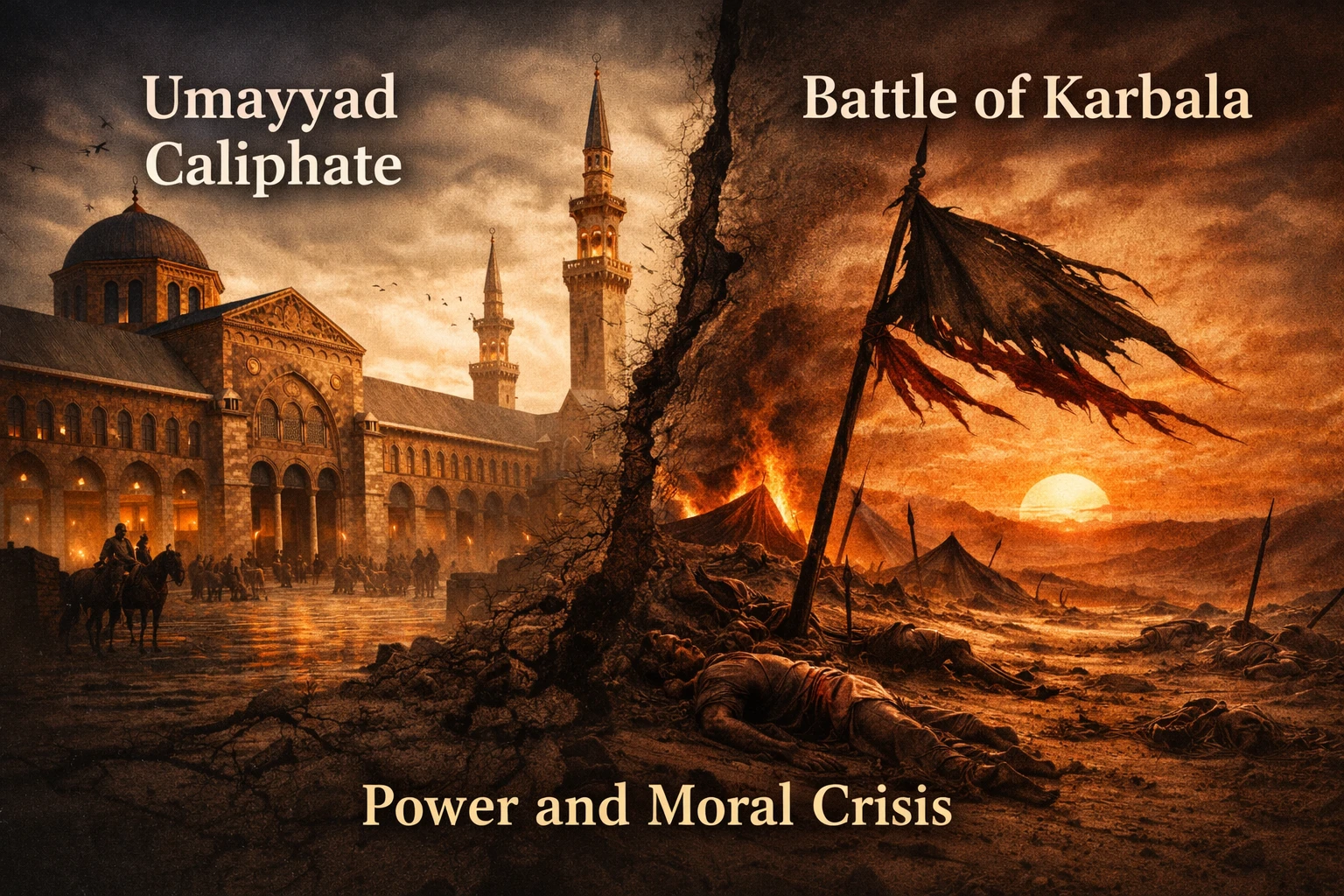
Umayyad Caliphate Power and Moral Crisis from Karbala to Abbasid Rise
When Leadership Changed Its Meaning
In the earliest days of Islam, leadership was never pursued—it was endured. Abu Bakr, Umar, Uthman, and Ali (may Allah be pleased with them) did not see authority as a prize to be won, but as a burden to be carried. Their power came directly from proximity to revelation, from living with the Prophet Muhammad ﷺ, absorbing not only his words but his character, restraint, and fear of Allah.
But history does not remain suspended around ideal moments. As the generation of the Companions began to fade, the Islamic world entered a phase it had never experienced before: power without prophetic presence. The Qur’an was preserved, the Sunnah was known, yet leadership now had to operate without the living moral compass of the Messenger of Allah ﷺ.
This absence would change everything.
A World Too Large for Simplicity
By the mid-7th century, the Muslim polity was no longer a regional community centered on Madinah. It was a vast, multi-ethnic, multi-cultural realm stretching from North Africa to Persia. Cities that had once answered to Byzantine emperors or Persian kings were now under Muslim rule. With this expansion came wealth, bureaucracy, armies, and borders that needed constant defense.
The Rashidun model had survived because of extraordinary individuals living in extraordinary circumstances. But the new reality demanded something different. Governors had to rule distant lands. Armies had to be funded and controlled. Internal dissent could no longer be handled by personal persuasion alone.
A silent realization began to take hold: faith alone could inspire obedience, but it could not manage empire.
Muawiya ibn Abi Sufyan and the Rise of Political Consciousness
Muawiya ibn Abi Sufyan (RA) did not emerge from obscurity. He was a Companion of the Prophet ﷺ, a scribe of revelation, and a man shaped by years of governance in Syria. Unlike leaders formed in the intimate environment of Madinah, Muawiya ruled from Damascus—a city accustomed to imperial order, hierarchy, and diplomacy.
His leadership reflected this background. Muawiya valued patience over confrontation, strategy over impulse, and stability over idealism. Where earlier caliphs relied heavily on moral authority, Muawiya relied on political intelligence. He understood alliances, managed rivalries, and controlled power with careful calculation.
This was not hypocrisy. It was adaptation.
Under his rule, the Muslim state stabilized after years of internal conflict. Borders were secured, rebellions were contained, and administration became more structured. Islam did not retreat during this period—it consolidated.
Yet beneath this success, a fundamental shift was taking place.
Succession and the Birth of Dynastic Thinking
The most decisive moment of Muawiya’s reign was not a battle or treaty, but a choice. When he nominated his son, Yazid, as successor, he introduced a principle that had never existed in Islamic leadership before: inheritance of rule.
From Muawiya’s perspective, this decision was meant to prevent chaos. The Ummah had already witnessed civil war, assassinations, and division. A disputed succession could reopen wounds that had barely healed. A clear line of authority, he believed, would protect unity.
But history judges outcomes, not intentions.
By turning leadership into something that could be passed down, the caliphate quietly transformed into kingship. Authority was no longer something the community entrusted—it was something a family claimed.
This moment did not destroy Islamic governance, but it altered its soul.
From Moral Authority to Political Legitimacy
The Rashidun caliphs derived legitimacy from character, sacrifice, and communal trust. Umayyad rulers increasingly derived legitimacy from control, order, and continuity. The caliph was no longer the first among equals; he was the head of a ruling house.
This created a tension that would define the Umayyad era. The state could command obedience, but it struggled to command hearts. Islam continued to guide law and worship, but politics began to shape how power was justified and defended.
Leadership now required not only righteousness, but survival.
The Psychological Shift: Rulers Raised in Power
Another transformation occurred quietly but decisively. Umayyad rulers were not raised in the shadow of the Prophet ﷺ. They were raised in courts, surrounded by administrators, soldiers, and privilege. Their understanding of Islam was real, but their relationship with power was fundamentally different.
This did not automatically make them corrupt or irreligious. But it did shape their instincts. Decisions were now made with an awareness of threats, rivals, and legacy. Governance became less about personal example and more about institutional strength.
Islam remained the foundation—but power had developed its own logic.
Umar ibn Abd al-Aziz: Proof That the Shift Was Not Inevitable
Within this dynastic system, Umar ibn Abd al-Aziz stands as a striking exception. Though an Umayyad by lineage, his spirit reflected the Rashidun legacy. He lived simply, ruled justly, and feared Allah deeply. He returned wealth taken unjustly, ended discriminatory policies against non-Arab Muslims, and treated leadership as accountability, not entitlement.
His reign demonstrated a critical truth: the Umayyad system itself was not inherently un-Islamic. What mattered was the intention and character of those who ruled within it.
Yet the fact that Umar ibn Abd al-Aziz stands out so sharply also reveals how rare such leadership had become.
A Shift That Could Not Be Reversed
By the end of the early Umayyad period, the transformation was complete. Leadership in the Muslim world had moved decisively from companionship to kingship, from moral intimacy to political authority. The Umayyads did not abandon Islam—but they reshaped how Islam functioned within power.
This shift allowed the Muslim state to survive and expand. But it also planted tensions that could not remain buried. Questions of legitimacy, justice, and moral authority were no longer theoretical. They were personal, emotional, and explosive.
Rebellion, Fitna, and the Moral Fracture of the Ummah When Political Power Lost Its Ethical Center
The Unresolved Tension After Mu‘awiya
After the death of Mu‘awiya ibn Abi Sufyan (RA), the Muslim world entered a phase that appeared politically settled but was morally unsettled. The Umayyad state had administrative order, military discipline, and territorial strength, yet many Muslims sensed that something fundamental had shifted. Leadership was no longer emerging from consultation or communal consent; it was becoming inherited authority. This change did not immediately break the system, but it quietly altered how people understood legitimacy. The question was no longer whether Islam ruled the land, but whether Islamic values ruled power itself.
For ordinary Muslims, this tension was confusing. Islam was victorious outwardly, yet inwardly many felt distant from the spirit they associated with the Prophet ﷺ and the rightly guided period. That distance created emotional and ethical discomfort — the kind that does not explode instantly, but slowly builds pressure beneath the surface.
Husayn ibn Ali (RA): A Moral Stand, Not a Political Campaign
Husayn ibn Ali (RA) must be understood correctly, or Karbala makes no sense. He was not a rebel seeking the throne, nor a naïve idealist unaware of political realities. He was a man carrying the moral memory of Islam in his blood and conscience. As the grandson of the Prophet Muhammad ﷺ, he embodied a living standard against which power was silently measured.
When Yazid demanded allegiance, Husayn (RA) recognized what many others tried to avoid: this was not merely about one ruler, but about setting a precedent. If unquestioned loyalty replaced accountability, then the Ummah would lose its moral voice forever. His refusal was calm, reasoned, and deeply rooted in principle. Even as letters arrived from Kufa promising support, Husayn (RA) did not move with blind optimism. He moved because silence itself had become a form of betrayal.
This is why Karbala cannot be reduced to a political miscalculation. It was a conscious choice to expose injustice, even if exposure came at the cost of life.
Karbala: When Power Faced Truth and Chose Force
The events at Karbala represent one of the most devastating moral moments in Islamic history. A small group, deprived of water, surrounded by a state army, stood firm not because they believed they would win, but because they believed truth must be witnessed. Husayn (RA) did not seek bloodshed; he sought moral clarity. Yet the machinery of power had already decided that obedience mattered more than justice.
The martyrdom of Husayn (RA) did not weaken Islam — it redefined resistance within Islam. From that day onward, Muslims understood that injustice clothed in Islamic language was still injustice. Karbala became a mirror held up to authority, reflecting what happens when power divorces itself from compassion, humility, and accountability.
Umayyad Caliphate Power and Moral Crisis from Karbala to Abbasid Rise
Character Analysis: Central Figures of the Fitna
| Figure | Role | Moral Position | Historical Impact |
|---|---|---|---|
| Husayn ibn Ali (RA) | Moral resistor | Refusal to legitimize injustice | Eternal symbol of principled resistance |
| Yazid ibn Mu‘awiya | Ruling authority | Power-first governance | Permanent controversy over legitimacy |
| Abdullah ibn al-Zubayr (RA) | Alternative leadership | Sacred legitimacy from Makkah | Prolonged challenge to Umayyads |
| Umayyad governors | State enforcers | Order through force | Strengthened state, weakened trust |
This table matters because Islamic history is not abstract — it moves through people making choices under pressure.
Abdullah ibn al-Zubayr (RA): Power Rooted in Sacred Memory
Parallel to Karbala, another challenge emerged in Makkah under Abdullah ibn al-Zubayr (RA). Unlike Husayn (RA), Ibn al-Zubayr pursued actual governance, presenting himself as a legitimate ruler grounded in proximity to the Haram and early Islamic legacy. His rule was not symbolic; it was functional, attracting allegiance across regions.
The fact that the Umayyads had to use military force — including operations near the Ka‘bah — to defeat him deeply disturbed Muslim conscience. Even those who valued stability could not ignore the spiritual cost of enforcing authority through sacred violation. The Umayyads won control, but lost moral intimacy with the Ummah.
The Kharijites: Extremism Born from Moral Collapse
Where moral clarity disappears, extremism often grows. The Kharijites emerged as a harsh response to what they perceived as irredeemable corruption. Rejecting nuance entirely, they declared rulers — and often fellow Muslims — illegitimate. Their rigid worldview offered certainty, but at the cost of mercy and wisdom.
Their repeated revolts and brutal suppression highlight an uncomfortable truth: injustice does not only create rebellion, it creates radical absolutism. The Umayyads fought them militarily, but the ideological conditions that produced them were rooted in deeper failures of justice and trust.
Core Themes Running Through the Fitna
Moral authority vs political authority is the central theme of this era. Power existed, but conscience resisted.
Memory vs pragmatism shaped Muslim responses — many remembered how leadership once felt, even if they could not restore it.
Sacrifice over survival emerged as a new moral language, especially after Karbala.
Faith tested by governance, not by disbelief — Islam was practiced, but ethics were contested.
These themes did not end with the Umayyads. They became part of the DNA of Islamic political thought.
Why This Era Still Matters
This period explains why later Muslims questioned rulers, debated obedience, and emphasized justice as a condition of legitimacy. The Abbasid revolution did not appear from nowhere — it was born from wounds left unhealed. Karbala, Ibn al-Zubayr, and endless revolts ensured that power could never again claim innocence.
Islamic civilization survived this fracture, but it did so with scars — scars that taught Muslims to fear tyranny more than chaos, and conscience more than comfort.
Umayyad Caliphate Power and Moral Crisis from Karbala to Abbasid Rise
Key Takeaways
- Karbala was a moral stand, not a political gamble
- Power without accountability breeds rebellion and extremism
- The Umayyads maintained control but lost ethical intimacy
- This era shaped Muslim attitudes toward authority forever