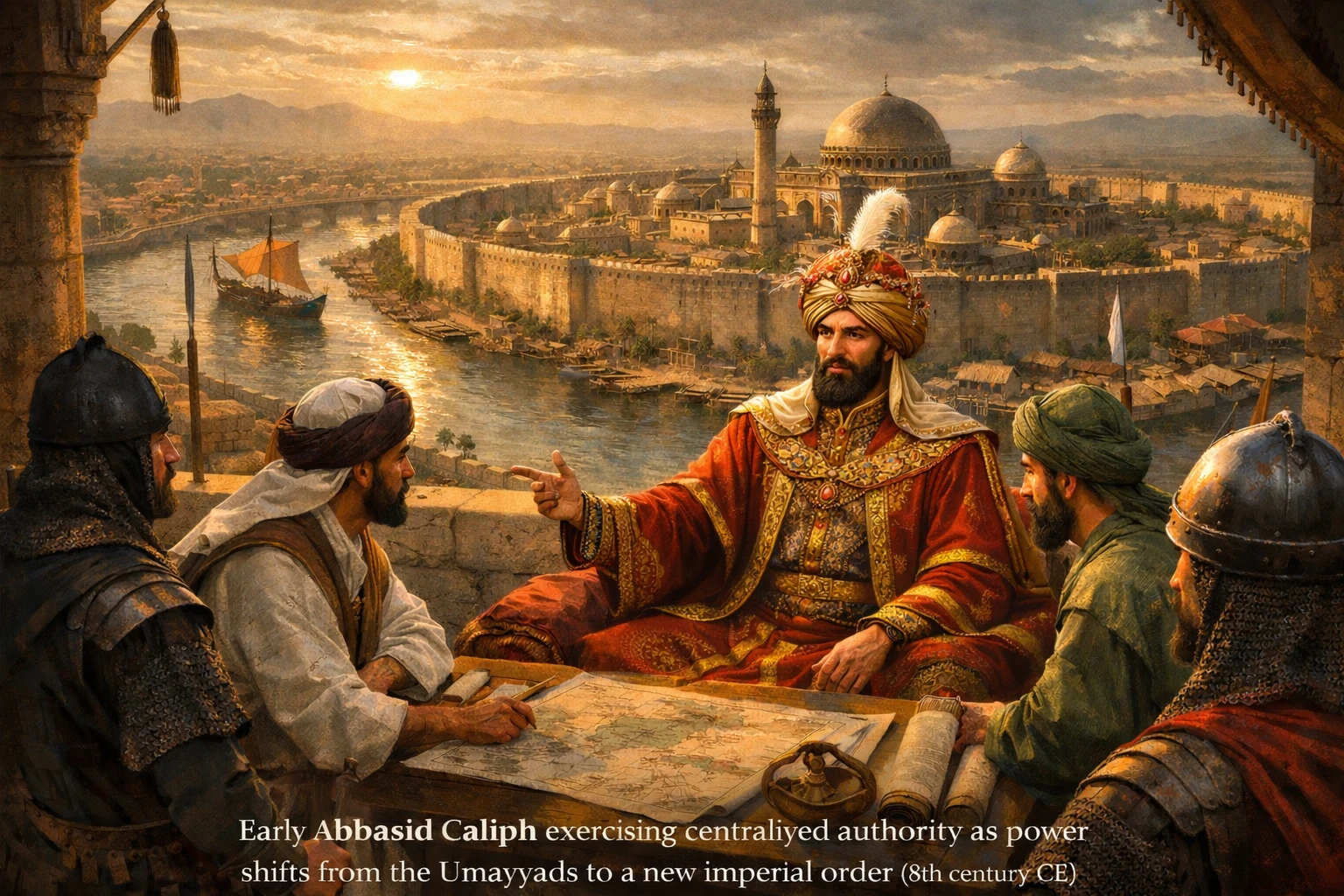
Early Abbasid Caliphate Power Baghdad and Political Change
In the middle of the eighth century, the Islamic world stood at a rare historical pause. The Umayyad Caliphate had fallen, but the Abbasid Caliphate had not yet fully become what history would later remember it to be. Between 750 and 770 CE, power existed in a fragile, unsettled state. Armies had won battles, banners had changed, and a new caliph sat on the throne, yet none of this guaranteed control. What followed was not an age of slogans or idealism, but a period of hard political decisions, administrative experimentation, and cultural realignment. The Abbasids did not merely inherit an empire; they had to rebuild the logic of rule itself after decades of Umayyad governance had reshaped society, loyalties, and expectations.
This early Abbasid phase matters because it explains how Islamic power survived revolution. Without understanding this moment, the consolidation of authority, the founding of Baghdad, the reshaping of administration, and the integration of knowledge into governance, later Abbasid achievements and failures make little sense.
The Problem the Abbasids Inherited
When Abu al-ʿAbbās al-Saffāḥ was proclaimed caliph in Kufa in 750 CE, the Abbasids ruled through a coalition, not a state. Their revolution had succeeded because it united groups with deeply different motivations: Khurasani Arab soldiers frustrated by Umayyad favoritism toward Syria, Persian converts marginalized under Arab tribal hierarchies, religious figures angered by Umayyad moral authority, and political families seeking access to power. This coalition could overthrow a dynasty — but it could not govern an empire without fragmenting.
The Abbasids immediately faced a structural dilemma:
How do you reward supporters without creating new centers of power strong enough to challenge the throne?
Under the Umayyads, the answer had been tribal privilege and military dominance. That model had collapsed. The Abbasids needed something more durable.
Abu al-ʿAbbās al-Saffāḥ: Power Before Ideals
Abu al-ʿAbbās is often remembered for his brutality toward surviving Umayyads, but this focus misses the deeper logic of his actions. His reign (750–754 CE) was short, but it established the Abbasid instinct for preventive control. The elimination of Umayyad claimants was not simply revenge; it was a calculated effort to erase alternative symbols of legitimacy.
More important than executions, however, was the Abbasid realization that revolutionary legitimacy expires quickly. Victory on the battlefield does not guarantee obedience in provinces like Egypt, Ifriqiya, or Transoxiana. Al-Saffāḥ therefore emphasized two priorities: central control of military pay and the redistribution of provincial governorships away from entrenched elites.
This was the first clear signal that Abbasid rule would not be a continuation of Umayyad habits with a different family name. Authority would be centralized, managed, and monitored.
Abu Muslim al-Khurasani: The Man Who Had to Fall
No figure better illustrates Abbasid anxiety than Abu Muslim al-Khurasani. He was the architect of the Abbasid Revolution in the east, commanding immense loyalty among Khurasani troops and Persian converts. In practice, he ruled Khurasan like an independent prince.
For the Abbasids, Abu Muslim represented an unbearable contradiction: the man who made their rule possible was also the man most capable of ending it.
When Caliph al-Manṣūr ordered his execution in 755 CE, it was not an emotional act but a strategic one. By removing Abu Muslim, the Abbasids sent a clear message to all power brokers: no revolutionary hero stands above the caliphate. This decision stabilized Abbasid authority but came at a moral cost. The revolution’s promise of justice and inclusivity was replaced by a colder truth — the caliphate would survive through control, not gratitude.
Al-Manṣūr and the Architecture of Authority
If al-Saffāḥ secured the throne, Abu Jaʿfar al-Manṣūr (r. 754–775 CE) built the state. His reign marked the true beginning of Abbasid consolidation. Unlike his brother, al-Manṣūr distrusted emotional legitimacy. He believed power endured only when embedded in institutions.
This belief shaped his most consequential decision: the founding of Baghdad in 762 CE.
Baghdad: A City Designed to Rule
Baghdad was not chosen randomly, nor was it built for beauty. Its location along the Tigris River placed it at the intersection of Persian bureaucratic culture, Arab military routes, and international trade networks. More importantly, Baghdad symbolized a deliberate break from Umayyad geography. Damascus had been Syrian, Arab, and tribal. Baghdad would be imperial, multiethnic, and administrative.
The city’s circular design placed the caliph’s palace and mosque at the center, with bureaucratic and military quarters radiating outward. This was architecture as ideology. Power flowed from the caliph; society revolved around the state.
Baghdad’s rise also marked a cultural shift. Persian administrators, scribes, and scholars gained influence. Arabic remained the language of law and religion, but governance absorbed Persian methods of record-keeping, taxation, and protocol. The Abbasid state became less tribal and more bureaucratic, a transformation that permanently altered Islamic governance.
Administration: How the Abbasids Actually Governed
The Abbasids professionalized rule. The office of the vizier emerged as a central institution, coordinating finance, correspondence, and provincial oversight. Governors were appointed with clearer mandates and rotated more frequently to prevent local entrenchment. Taxation systems were standardized, not softened — predictability, not mercy, was the goal.
This administrative order reduced rebellion by reducing uncertainty. Subjects might resent taxes, but they understood them. Arbitrary extraction, which had fueled Umayyad unrest, was replaced by structured obligation.
Yet this efficiency carried consequences. As bureaucracy expanded, caliphs became dependent on officials whose loyalty was personal, not ideological. Over time, this dependence would weaken direct caliphal authority — but in the early phase, it gave the Abbasids stability their predecessors lacked.
Knowledge as Power, Not Ornament
Perhaps the most misunderstood aspect of early Abbasid rule is their patronage of knowledge. The translation of Greek, Persian, and Indian works into Arabic was not a cultural hobby. It was statecraft.
Astronomy regulated calendars and navigation. Medicine sustained urban populations. Philosophy sharpened legal reasoning. By sponsoring knowledge, the Abbasids strengthened governance while enhancing legitimacy. The caliph appeared not only as a ruler, but as a custodian of civilization.
This intellectual openness forced Muslim scholars to define Islamic theology and law with greater precision. The result was not dilution, but maturation. Islamic thought grew deeper precisely because it engaged with new ideas.
Society Under the Early Abbasids
For ordinary people, Abbasid consolidation reshaped daily life. Cities expanded. Markets flourished. Non-Arab Muslims gained access to administration and scholarship. Social mobility increased — not because hierarchy disappeared, but because lineage mattered less than competence.
At the same time, rural communities bore heavier fiscal pressure. Urban prosperity was unevenly shared. These tensions did not explode immediately, but they lingered beneath the surface of Abbasid stability.
Themes and Symbolism: What the Abbasids Represented
At its core, the early Abbasid project symbolized a transformation in how Islamic power justified itself.
From conquest to administration.
From tribe to institution.
From charisma to system.
This shift raised expectations. Rulers were now judged not only by strength, but by justice, competence, and moral restraint. The Abbasids benefited from this new standard — and would later suffer under it.
Connection to Later Abbasid History
The choices made between 750 and 770 CE shaped everything that followed:
- Baghdad’s rise enabled the Islamic Golden Age
- Bureaucratic rule encouraged long-term stability
- Military professionalization paved the way for later Turkish dominance
- Scholarly autonomy limited absolute caliphal power
The Abbasids survived longer than the Umayyads not because they were more virtuous, but because they built structures capable of absorbing tension.
Conclusion: Not a Golden Age, but a Foundational One
The early Abbasid period was not an era of perfection. It was an era of deliberate construction. Faced with the collapse of Umayyad legitimacy, the Abbasids chose endurance over idealism and order over revolutionary purity. In doing so, they reshaped Islamic civilization.
What fell with the Umayyads was not Islam, but a vision of power rooted in tribal dominance. What rose under the Abbasids was something heavier and more complex — a state capable of greatness, contradiction, and survival.
Key Takeaways
- Abbasid power was consolidated through institutions, not slogans
- Baghdad was a political strategy, not just a capital
- Administration and knowledge became tools of governance
- Early stability came at long-term moral and political cost
FAQ
Why did the Abbasids move the capital to Baghdad?
To break Umayyad tribal dominance and centralize imperial administration.
Was the Abbasid Revolution religious or political?
It was both — religious language legitimized a fundamentally political restructuring.
Did Abbasid rule fulfill Islamic ideals better than the Umayyads?
Partially. It improved inclusion and governance but introduced new hierarchies.